Key Points
- "No Common Wall" means no residential living space is shared between two units
- It is an architectural approach requiring significantly more land and design complexity
- Benefits: privacy, acoustics, ventilation, Vastu compliance, resale value
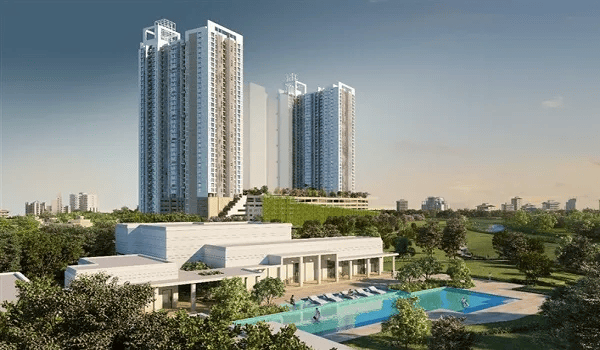
- DSR The Address achieves this across all 1,372 units — a rare scale execution
- Only utility shafts and building corridors are shared — never bedrooms or living rooms
What Does "No Common Wall" Actually Mean?
In the vast majority of apartment complexes — even premium ones — two adjacent units share a structural lateral wall. This wall is common property, and it carries structural loads for both units simultaneously. This design maximises the number of units on a floor plate and is the standard approach in most high-rise residential construction.
The problem with shared lateral walls is threefold: sound, privacy, and Vastu. Because the wall is structural and shared, sound transmission between units is hard to eliminate entirely. Bedroom walls that back up against a neighbour's living room or kitchen become a significant quality-of-life issue over time. From a Vastu perspective, a shared wall implies incomplete energetic independence for each home.
No Common Wall is a design philosophy that addresses this from the ground up. Instead of units sharing lateral walls, the floor plate is designed so that each apartment is surrounded on all sides by either external air gaps, service shafts, or common circulation corridors — never another family's living space.
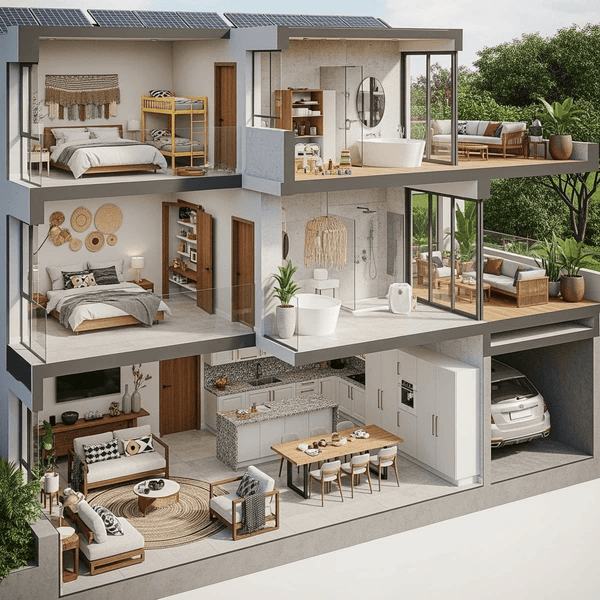
Why Does It Matter? The Real-World Benefits
1. Privacy & Acoustics
When no shared wall exists between living spaces, noise transmission drops dramatically. You don't hear your neighbour's late-night calls through the bedroom wall. You don't hear their kitchen exhaust through your study. The acoustic separation makes a tangible difference to daily life that becomes increasingly apparent over years of living.
2. Superior Ventilation
No Common Wall designs typically result in better cross-ventilation because units can have openings on more sides. At DSR The Address, this means better natural airflow through each apartment, reducing dependence on air conditioning and improving indoor air quality.
3. Vastu Compliance
For a large segment of Bangalore's homebuyers — and the Indian market broadly — Vastu Shastra is a genuine consideration. A No Common Wall design means the energetic space of each home is genuinely independent, which is the most complete form of Vastu compliance an apartment can achieve. This is usually only possible in independent villas — which makes DSR The Address's design especially notable.
4. Resale Value
As buyer awareness grows, "No Common Wall" is increasingly becoming a premium attribute that commands a price differential in the secondary market. Buyers who understand this feature are willing to pay more for it — which benefits owners at the time of resale.
The Engineering Challenge: Why Most Developers Don't Do It
If No Common Wall is so desirable, why don't more developers adopt it? The answer is economics and complexity.
- More land required: Separating units requires more space per floor, reducing FSI utilisation efficiency
- More complex structural engineering: Eliminating shared load-bearing walls requires alternative structural systems — often concrete shear walls or moment frames rather than simple column-beam grids
- Fewer units per floor: The natural consequence of more spacing is a lower unit count per tower, which reduces revenue per construction cost for developers
- Higher material cost: More structural material is required when shared walls cannot serve double-duty
DSR Projects's willingness to accept these trade-offs — lower unit density, higher construction complexity — in service of buyer experience is a meaningful statement about their product philosophy.
How DSR The Address Implements It
The No Common Wall design at DSR The Address is executed through a distinctive cruciform (cross-shaped) tower plate. Each apartment in Towers 1–5 has the following adjacency profile:
- North/South faces: External facade (open to air and view)
- East/West faces: Service shafts or building corridors, never another unit's living space
- All bedrooms and living rooms: Face either the external environment or a dedicated air gap — never another home
Tower 3's exclusive 4 BHK floor plates take this even further — with each apartment occupying a half-floor or full-floor plate, making wall-sharing structurally impossible from the outset.
See the Floor Plates for Yourself
Request the full floor plan for 2, 3 & 4 BHK configurations at DSR The Address.
A Standard Worth Setting
No Common Wall is not a marketing phrase at DSR The Address — it is a structural commitment embedded in the architecture of every tower. In a market where "luxury" has become diluted by overuse, this is the kind of concrete, verifiable differentiator that sets a project apart for discerning buyers who know what they're looking for.
If privacy, acoustic quality, Vastu compliance, and resale value are part of your homebuying criteria — and they should be — DSR The Address on Sarjapur Road, Dommasandra, is the benchmark project to evaluate in 2026.
Frequently Asked Questions
What exactly does 'No Common Wall' mean in an apartment?
It means the residential living space (bedrooms, living room, kitchen) of your unit does not share a direct wall with an adjacent unit, ensuring maximum privacy and noise reduction.
Are there any shared walls at all in DSR The Address?
In DSR The Address, apartments only adjoin service shafts or building corridors. No two families share a lateral living wall.
How does this design improve acoustic privacy?
By eliminating shared walls, structural noise transmission (like TV sound or conversations) from neighbors is virtually eliminated, creating a villa-like quiet experience.
Is 'No Common Wall' design Vastu compliant?
Yes, it is considered highly Vastu compliant as each unit acts as an independent energetic core, free from the structural interference of neighboring units.